
Have you ever wondered why products arrive damaged even though they were wrapped and palletised correctly at the warehouse? Or why logistics costs quietly increase despite stable shipping volumes? In many cases, the issue is not transport distance or handling—it is pallet wrapping stability.
In modern supply chains, pallet wrapping is more than a final packaging step. It plays a critical role in protecting goods, controlling costs, and maintaining operational efficiency. When wrapping stability is inconsistent, hidden costs start to accumulate across storage, transport, labour, and customer service.
This article explains how pallet wrapping machine stability directly impacts supply chain performance, why unstable loads are more expensive than they appear, and how the right automatic wrapping machine and stretch film machine setup can significantly reduce avoidable costs.
Why Pallet Wrapping Stability Matters More Than You Think
Pallet wrapping stability refers to how securely goods are held together on a pallet during storage, handling, and transportation. A stable load resists shifting, collapsing, or loosening—even when exposed to vibration, braking forces, or stacking pressure.
While unstable pallets may still leave the warehouse, their impact is often felt later in the supply chain through:
- Product damage
- Safety incidents
- Delayed deliveries
- Customer complaints
- Repacking or rewrapping labour
- Increased material waste
These issues rarely appear as a single large cost. Instead, they accumulate quietly—making them difficult to track but costly over time.
The Hidden Costs of Poor Pallet Wrapping
1. Product Damage and Returns
One of the most obvious consequences of unstable pallet wrapping is product damage. When loads shift during transport, cartons may crush, topple, or tear open.
This leads to:
- Higher product returns
- Replacement and reshipping costs
- Loss of saleable inventory
- Customer dissatisfaction
Even minor instability can result in repeated micro-damages that erode profit margins, especially for high-volume operations.
2. Increased Transport and Handling Risks
Unstable pallets increase the risk of accidents during forklift handling, loading, and unloading. A poorly wrapped pallet can tip, slide, or collapse—posing serious safety hazards to workers.
From a cost perspective, this translates into:
- Workplace injury claims
- Equipment damage
- Insurance premiums
- Operational downtime
A stable pallet wrapping system significantly reduces these risks.
3. Excessive Stretch Film Consumption
Ironically, unstable pallet wrapping often leads to more film usage, not less. Operators may compensate for poor load stability by over-wrapping pallets with additional layers of film.
This results in:
- Higher stretch film costs
- Increased plastic waste
- Slower wrapping cycles
- Reduced throughput
A properly calibrated stretch film machine, paired with the right film, applies optimal tension—achieving stability without excess material.
4. Rewrapping and Rehandling Costs
When pallets arrive at distribution hubs or customer facilities with loose or damaged wrap, they often need to be rewrapped before further movement.
Rewrapping leads to:
- Additional labour hours
- Extra film usage
- Delays in distribution
- Congestion at receiving docks
These inefficiencies add up quickly, especially across regional or international supply chains.
5. Reduced Warehouse Efficiency
Unstable pallets cannot be safely stacked or stored at height, limiting warehouse space utilisation. This forces operations to:
- Use more floor space
- Reduce racking efficiency
- Increase storage costs
Stable pallet wrapping supports better vertical storage and safer warehouse layouts.
How Automatic Wrapping Machines Improve Load Stability
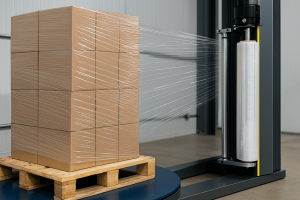
Manual pallet wrapping relies heavily on operator technique, fatigue levels, and consistency. In contrast, an automatic wrapping machine applies uniform tension, speed, and wrap patterns to every pallet.
This consistency is key to load stability.
Key stability advantages of automatic wrapping machines include:
- Controlled pre-stretch for optimal film tension
- Programmable wrap cycles tailored to load types
- Even film application from top to bottom
- Repeatable performance across shifts
When pallet wrapping is automated, stability becomes predictable rather than variable.
The Role of Stretch Film Machines in Stability Control
A stretch film machine is not just a dispenser—it is a tension management system. The machine controls how much the film stretches and how strongly it pulls back to hold the load together.
If the film is overstretched or understretched:
- Overstretching causes film breakage or weak holding force
- Understretching leads to loose wrapping and instability
Modern stretch film machines use pre-stretch technology to maximise film efficiency while maintaining strong load containment. This balance is essential for reducing hidden costs without compromising safety.
Why Machine–Film Compatibility Matters
One of the most overlooked causes of unstable pallet wrapping is poor compatibility between the wrapping machine and the stretch film used.
When film properties do not match machine settings:
- Film may tear at high speeds
- Load containment force becomes inconsistent
- Wrapping cycles slow down
- Machine downtime increases
High-performance machine-grade films are engineered to work seamlessly with automatic wrapping machines, ensuring consistent tension and reliable performance even at high speeds.
# Stability and Supply Chain Cost Control
Stable pallet wrapping has a direct impact on overall supply chain costs, including:
# Transport Efficiency
Stable loads reduce movement during transit, lowering damage rates and insurance claims.
# Operational Productivity
Automated, stable wrapping reduces rework, improves throughput, and minimises labour intervention.
# Material Optimisation
Correct tension and pre-stretch reduce film consumption without sacrificing load security.
# Customer Satisfaction
Well-protected pallets arrive intact, reducing complaints and improving delivery reliability.
Each of these improvements contributes to long-term cost savings that are often underestimated during packaging decisions.
Common Causes of Pallet Wrapping Instability
Understanding what causes instability helps prevent it. Common issues include:
- Inconsistent wrap tension
- Incorrect film type for the load
- Poor pallet load pattern
- Over-reliance on manual wrapping
- Inadequate machine calibration
Addressing these issues typically requires upgrading to an automatic wrapping machine and selecting a suitable stretch film machine configuration.
Why Stability Is a Strategic Advantage
In competitive supply chains, cost savings are not only achieved through lower purchase prices but through smarter process control. Pallet wrapping stability is a strategic advantage because it:
- Protects product value
- Reduces operational waste
- Improves safety
- Enhances brand reliability
Companies that invest in stable pallet wrapping systems often see measurable improvements across logistics KPIs—even if packaging costs appear unchanged at first glance.
Future Trends: Smarter Pallet Wrapping Systems
The future of pallet wrapping lies in data-driven stability control. Emerging systems offer:
- Sensor-based tension adjustment
- Load profile recognition
- Automated film optimisation
- Integration with warehouse management systems
These innovations aim to eliminate instability before it happens—further reducing hidden supply chain costs.
Final Thoughts: Stability Is Not an Option—It’s a Cost Control Tool
Pallet wrapping stability is not just about keeping products together—it is about protecting margins, people, and performance across the entire supply chain.
By using the right automatic wrapping machine and stretch film machine, businesses can:
- Minimise damage and rework
- Reduce film waste
- Improve safety
- Streamline warehouse operations
- Lower total cost of ownership
In a supply chain where every inefficiency compounds, stable pallet wrapping is one of the simplest and most effective ways to eliminate hidden costs before they occur.
Introducing Thong Guan Performance-Machine Film
Thong Guan Performance-Machine Film is developed for high-speed automatic pallet wrapping machines, offering consistent stretch, reliable load containment, and stable performance in automated environments. The range includes VELOCITY, NEXT, and PRIME series—each designed to support different operational requirements, from high-throughput lines to enhanced film efficiency and controlled wrapping performance.
Engineered for compatibility with modern pre-stretch systems, these films help maintain wrapping stability while supporting efficient material usage in automated pallet wrapping operations.