Net Zero & ESG Strategy: Thong Guan joins the race to zero

Net Zero & ESG Strategy: Thong Guan joins the race to zero

ESG or Environmental, Social, and Governance is commonly discussed these days. 

Investors and stakeholders increasingly include this factor in their evaluation of companies to identify material risks and growth opportunities. 

It measures a company’s ethical impact on the environment and the sustainability of its investment.

So why is ESG important to companies besides being worthy of investment?

Simply put, it’s for posterity sake. 

As standard operations of a company, ESG is becoming a solid culture to practice to ensure the company’s continuations. 

We can’t expect to do that if the world deteriorates. Thus, it should be, perhaps, a symbiotic relationship. 

If we take care of the environment, we can only have a conducive environment for a company to thrive.

And then we have Net-Zero.

What is Net Zero?

Net Zero is a much bigger and longer-term goal than for mere companies. 

Generally, the state of net-zero carbon dioxide (CO2) emissions is known as carbon neutrality. 

Obviously, we can achieve that by transitioning to a post-carbon economy. This means we must reduce CO2 released from, for instance, transportation, energy production, agriculture, and industry to a level where absorption by the environment is balanced. 

In other words, the balancing of carbon dioxide emissions with the removal through carbon offsetting.

The term Net Zero we hear today refers to more than just CO2 balance. It encompasses all greenhouse gasses (GHG) that affect our climate by increasing global temperature. Though, CO2 contributes the most.

We will reach net zero when the amount of GHG we add is no more than the amount taken away by nature.

Why does joining the race to zero matter? 

Paris Agreement @COP21

Through the Paris Agreement, enacted during COP21 in Paris in 2015, momentously, every country that attended agreed to work together to limit global warming to 1.5 degrees to minimise the impacts of changing climate.

Our commitment to the agreement is vital. Every degree matters as evidence show us that as our planet gets hotter, many lives are lost and livelihoods damaged.

According to the World Meteorological Organisation

(source: public.wmo.int)

  • The warmest 20 years on record have been in the last 22 years.
  • The warmest seven years were from 2015 to 2021 (the top 3 were 2016, 2019 and 2020).
  • The global average temperatures are 1ºC higher than in the pre-industrial era.

Most emissions come from just a few countries.
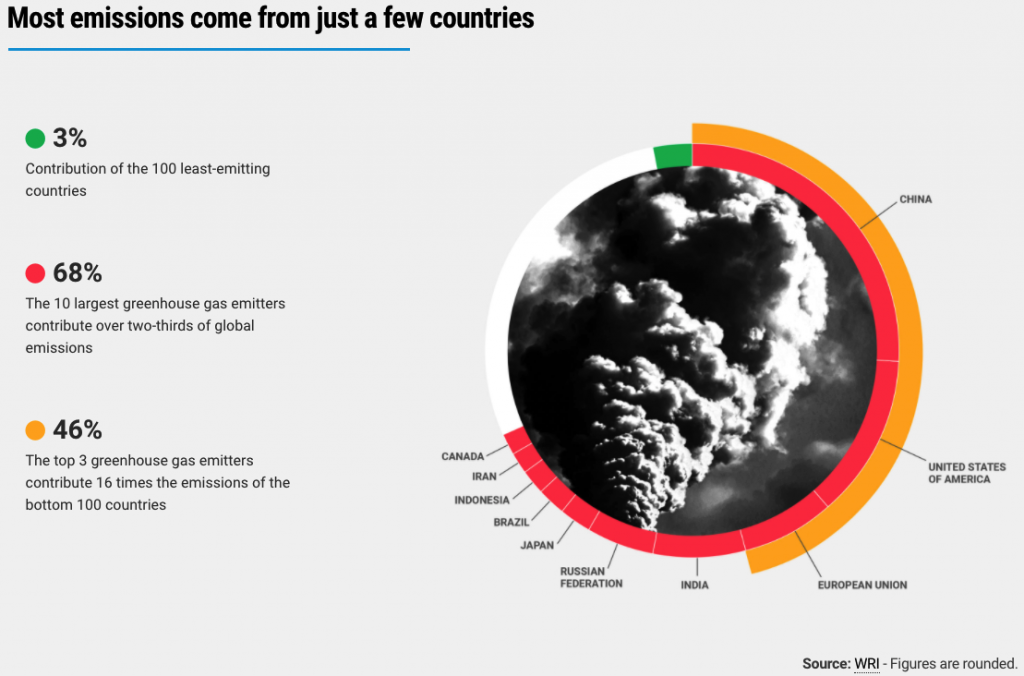
Net Zero & ESG Strategy - GHG Emitters around the world

If this trend continues, predictably, global temperature will increase by as much as 3 to 5ºC by 2100.

We must reign in our GHG, mainly CO2, emission at every level as much as possible to curb the impact of global warming.

As such, the Paris Agreement had countries committed to bringing forward national plans (Nationally Determined Contributions or NDCs), setting out how much they would reduce their emissions. And they agreed that every five years, they would come back with an updated plan that would reflect their highest possible ambition at that time. 

For a livable climate, many countries have submitted their NDCs.
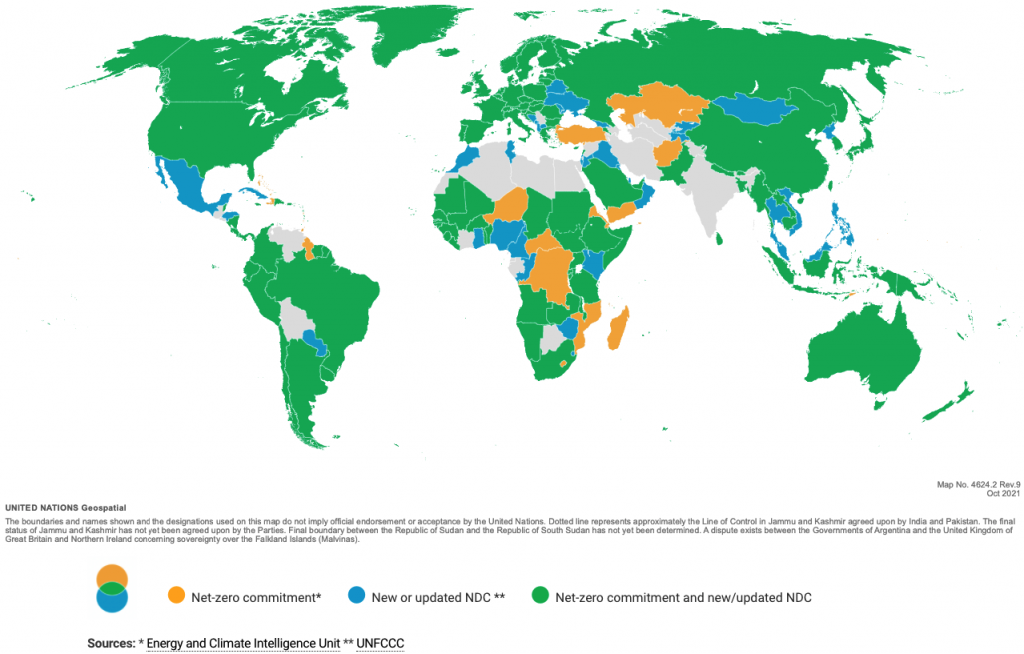
Net Zero & ESG Strategy - Commitments around the world

How can we contribute to the race to zero in the plastic packaging industry?

Be it in the country, companies or individuals, tackling climate change is now at the top of the agenda. 

The same goes for Thong Guan.

At Thong Guan, our primary focus has always revolved around product excellence, load stability & safety, and quality & performance consistency.

As these are focused on sustainability at the baseline, it helps to reduce the hidden sustainability impact, such as reducing

  • damaged goods on arrival, which are wastes of packaging materials, transportation and the goods produced
  • the need for more stretch wrapping where optimisation means less unnecessary wasted plastic wrapping

That’s not all. 

We hope that with our ESG strategy in place and going strong, we can join in the race to achieve Net Zero by 2050.

Here are some of our ESG strategies & efforts over the years.

Thong Guan has been recycling for more than 20 years

Plastic packaging is made from natural gas and crude oil, “cracked” into ethylene and propylene in resins form. They are then combined using various formulas into polymers.

We all know that for every kilogram of fossil-based plastic produced, there are between 1.7 and 3.5 kilograms of carbon dioxide released (source: woodly.com by Tomi Nyman, Chief Commercial Officer of Woodly). From transporting the crude oil to processing, manufacturing the products, and disposing of plastic packaging releases CO2

Thong Guan has been recycling for more than 20 years as part of our ESG goals to reduce the carbon footprint of plastics. In 2010, to further strengthen our resolve, we acquired a recycling facility known as TGSH today to collect and process post-industrial (PIW) and post-consumer plastic waste (PCW). 

Our subsidiary TGSH has about 5,000 metric tonnes of post-industrial and consumer recycled plastic resins annually.

Going beyond sustainability through product innovation

TG Bio Series

This year’s release of our TG Bio Series allows us to eliminate the need for non-renewable feedstock as raw materials for some of our products.
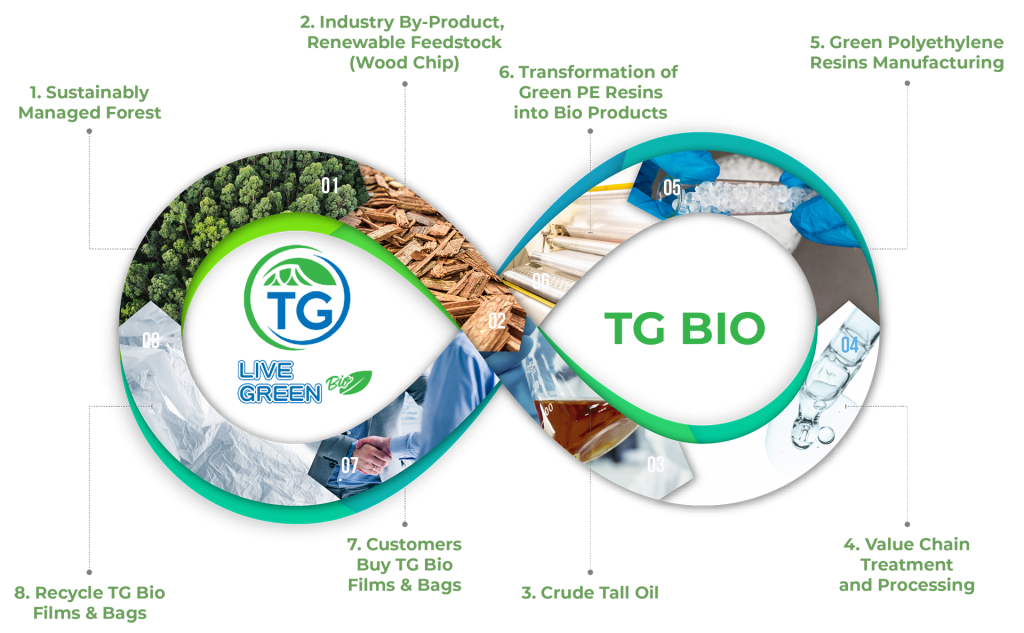
Some of the benefits of the TG Bio series includes

  • Replacing fossil products and raw materials;
  • 2.7 kg CO2/kg polyethene (PE) savings;
  • No food/feed competition;
  • No direct/indirect change in land use;
  • Recyclable; and
  • Sustainable forestry

Specially formulated using plastic resins made from tall oil, which is wood waste, our customers can now be part of the sustainability plan when they buy our bio-based stretch films.

What’s more, our bioplastic for our stretch film product range is a step beyond—we’re closing the loop of another industry.
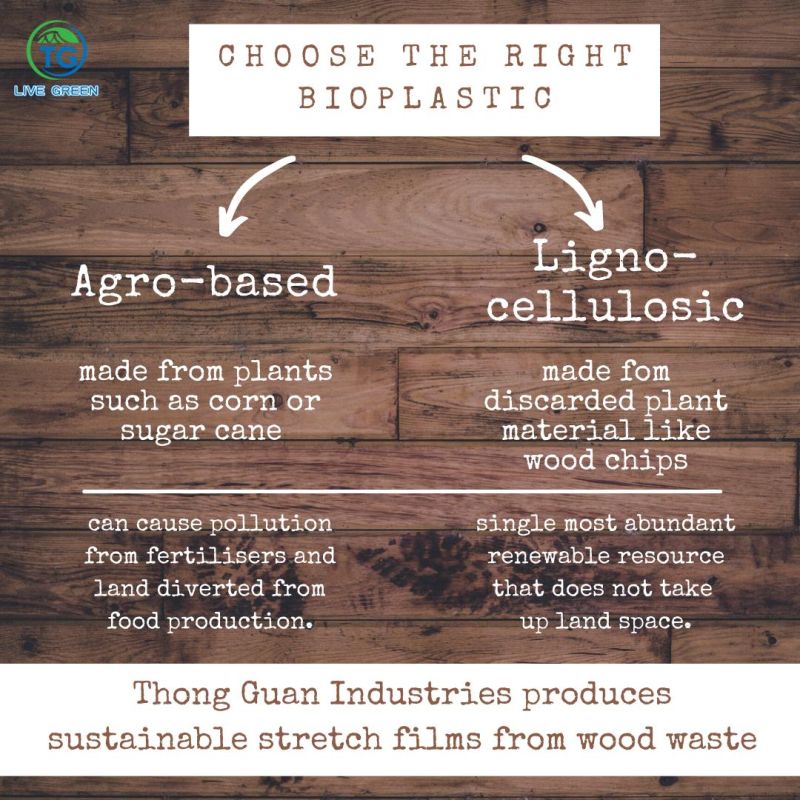
Net Zero & ESG Strategy - types of bioplastics

Other Product Innovation

  • iPak5: An IoT solution designed to provide customers with a data-centric ecosystem to have performance visibility and traceability, including film wastage and carbon emission saved

  • NanoGreen: A high-performance, 15-µm 30% recycled machine film

  • Bolt: A stretch film dispenser uniquely designed to achieve hand wrapping consistency with proper containment force, thus reducing waste from unnecessary wrapping or damaged goods

  • Nano Zero: Nanotech coreless stretch film offers less wastage and environmentally-friendly stretch film application

For more information regarding Thong Guan’s #LiveGreen Initiatives, please visit www.thongguan.com/live-green/.

Takeaway
Efforts may be small compared to others like those at the country level. However, we believe every effort counts in contributing to the bigger picture.

We challenge ourselves daily to go above and beyond to bring our business towards sustainability to contribute to Net Zero by 2050.

Join Thong Guan in the race to zero today! 

You may visit Thong Guan Sustainability Report 2021 to read more about Thong Guan’s Sustainability and ESG efforts. 

Email us at info@thongguan.com to find out more.

iPak5: How to Achieve Operational Excellence & Sustainability Goals

Thong Guan iPak5 Eagle Eye for operational excellence and sustainability goals, full visibility and traceability

There is a lack of visibility in the packaging industry. 

This means brand owners and packaging businesses are not tracing or tracking many vital variables necessary for operational excellence. 

Some of which includes

  • Downtime caused by film breaks
  • Inefficiency in your multisite factories
  • Film usage
  • Stretch percentage
  • And more

Additionally, the purchasing department continues to buy the cheapest film. 

While the production manager screams whenever the production lines go offline due to film breaks.

And the cycle goes on.

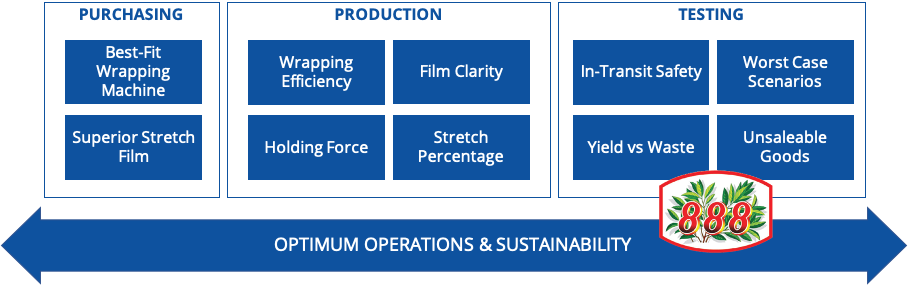
Excellent operations require business owners or packaging businesses to look at their entire system holistically. 

This means from the beginning of the entire operation to the end matters.

Thong Guan Newton Lab iPak5 production floor smooth operations factor

We understand the pain of not having visibility over your entire operations.

Questions like the following often materialised without answers.

  • Why is one site doing better than the other?
  • Why does this particular line always go offline?
  • Why do we have high unsaleable goods?
  • How do we reduce unsaleable goods?
  • Which film is the best for what I need?
  • What are my stretch film requirements?
  • How to ensure the most optimum usage of my films?

And when there is a possible answer, the investment in existing solutions may not justify the yield.

A Data-Centric Ecosystem Designed with Holistic Solutions in Mind

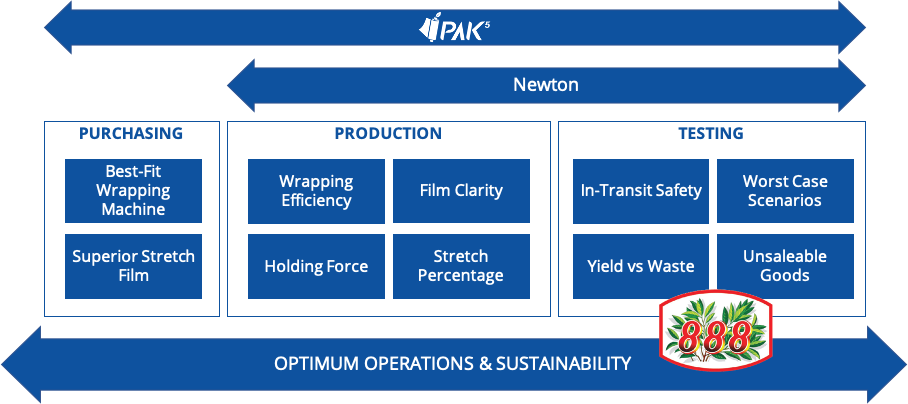
That is why Thong Guan, in partnership with Newton Europe, came up with iPak5.

It’s a simple solution that brings impact to your business at an affordable price.

Thong Guan great visibility traceability iPak5 Newton

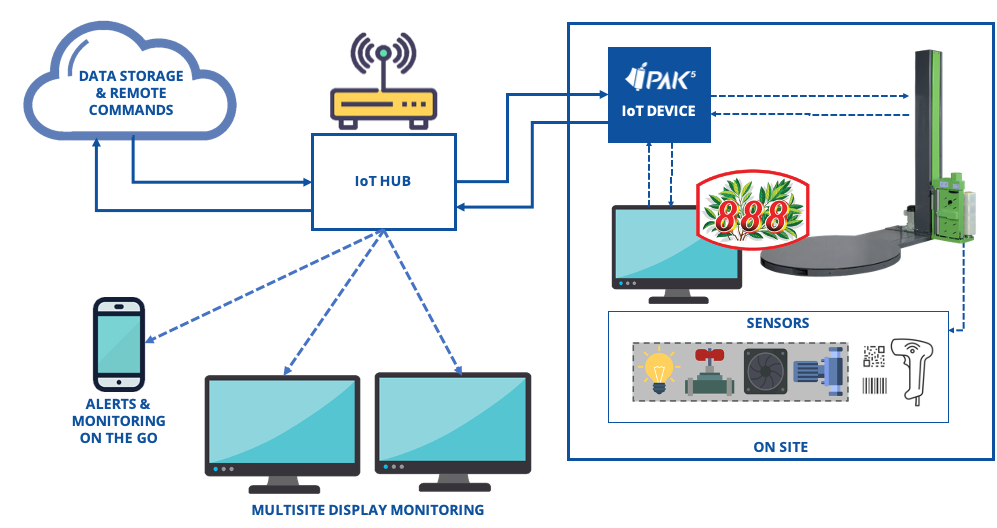
By seamlessly connecting your wrappers with our IoT solution developed in-house, you will now have an eagle eye view of your entire operations.

From the machine rolls to the wrapper, despite shift changes with different operators, you will retain consistency while tracking productivity and performance.

Thong Guan how iPak5 works

We will capture and analyse your operational data for valuable insights. 

So, as brand owners, you will not just know what is going on in your factories worldwide but make necessary business decisions to optimise your bottom line. 

Some of the insights and benefits you will gain are

  • Total films consumed
  • Alerts on downtime
  • Multisite monitoring
  • Stretch percentage
  • Estimated CO2 savings 
  • And more

The Implication of Optimum Operations

1. Performance visibility & traceability

Manual tracking of your entire operations at multiple sites around the world can be a pain.

But running a top-notch system that comes with a high price tag is not feasible in the long run.

Therefore, with iPak5, you can access the necessary data anywhere and anytime at a flexible, affordable price.

This also means speed to action when there are issues is attainable.

2. Reduction of product damages on arrival

Reducing unsaleables is a genuine problem every business owner is trying to achieve. 

But that usually comes with a high price tag.

Therefore, it is now possible with wrapping optimization using data at an affordable price.

So you can have peace of mind and a better bottom line in regards to product damages on arrival.

3. Safety improvements along the supply chain

Knowing the best-fit films, the optimum wrapping force, and film usage, your loads will get the most secured wrapping for transportation. 

This means no more unnecessary predicaments that lead to road safety or human safety issues.

4. Productivity boosting

With data, you could quickly and easily pinpoint the source of problems and act on them. 

This means less downtime.

With less downtime and more optimised operations, you can increase the productivity of your assembly line. 

That, in turn, impacts the entire supply chain and logistics.

5. Cost reductions in the long run

At an affordable price to integrate the modular-based iPak5 into your system, you can quickly turn all your wrapping machines into a network of data-centric equipment that comes with a smart feedback loop. 

Turning cost reduction plant-wide or multisite-wide possible, iPak5 helps you reduce film usage, unsaleables, and downtimes. 

These are all significant factors that contribute to costs incrementing and overrun resources.

6. Sustainability

Through optimum film stretch percentage that couples with data-driven test results from the Newton Lab, you will easily reduce the need for unnecessary wrapping.

With the estimation of carbon dioxide savings, you can easily collect the data for your sustainability goals report.

Branding wise, it’s a plus point to walk to talk with real data in terms of sustainability goals. 

As such, you are increasing your brand score among your customers.

7. Modularity & Portability

iPak5 can work with almost 99% of wrapping machines in the market. 

So you don’t have to obsolete all your wrapping machines to get started.

The barrier to entry towards operational excellence becomes so much attainable for you.

The Future Potential of iPak5 to Your Benefits

With the iPak5 ecosystem in place, there are endless possibilities for further optimisation of your operations. Which, in turn, will lead to an improved bottom line.

Some of which may include

  • Smart inventory management based on film usage that reduces warehouse costing
  • Optimisation of best-fit film based on past data and simulation test data through the Newton Lab top-notch facility that gives the best value for your investment
  • The fast expansion of production line by duplicating successes
  • Smart distribution centres and packaging logistics system

The possibilities are endless.

In Summary

To optimise your operations and achieve your sustainability goals, you will need big data. 

However, solutions should not be unattainable or overly costly.  

That is why we all need simple yet impactful solutions. 

This may not be achievable until now.

With iPak5, you can have an eagle-eye view of your entire operations that boosts your operational excellence and help you many steps closer to your sustainability goals.

For more information or to get started, contact info@thongguan.com.

Why Should We Focus on Post-Consumer Recycled Resins?

Thong Guan Why focus on post-consumer recycled resins global plastic waste

As Thong Guan progressively adopts the sustainability culture, we continue to engineer and innovate products with post-consumer recycled resins.

The post-consumer recycled (PCR) resin market is projected to reach USD 31,420 million by 2026 (from USD 30,070 million in 2020). 

It is also expected to grow with a healthy growth rate of more than 0.7% from 2021 thru 2026.

With the growing trend of recycled resins market, we look into why PCR and explore the advantages and opportunities of using post-consumer recycled resins.

Defining PCR & PIR Plastic Resins

The ISCC Plus has clearly distinguished the differences between PCR and PIR resins.

Briefly, PCR plastic resins are

  • Plastic materials generated by end-users products 
  • From end-users of households, commercial, industrial & institutional facilities
  • Products that can no longer be of use for their intended purpose
  • Also, materials return from the distribution chain

Why Post-Consumer Recycled Resins & the Climbing Growth Rate of PCR Resin Market

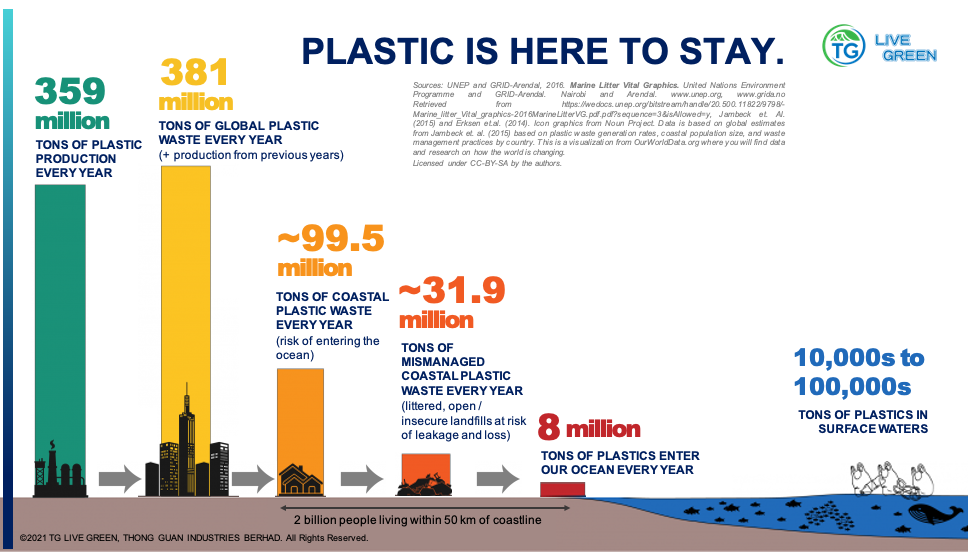
Every year, the global primary production of plastics amounts to a whopping 359 million tonnes

The plastic waste itself, when improperly managed, is at risk of leakage to the environment every year—an estimated 8 million tonnes of plastics enter our ocean every year.

Thong Guan Why focus on post-consumer recycled resins global plastic waste

(Source: UNEP and GRID-Arendal, 2016)

The production of plastics is expected to continue rising steadily.

This means more plastic waste.

That is why it matters to us that we address sustainability as everyone’s responsibility—because it takes more than just one party to make the recycling and circular economy work.

Plastic is undeniably one of the greatest inventions of the last century. Without plastics, many inventions became almost impossible.

Therefore, plastic is not the problem.

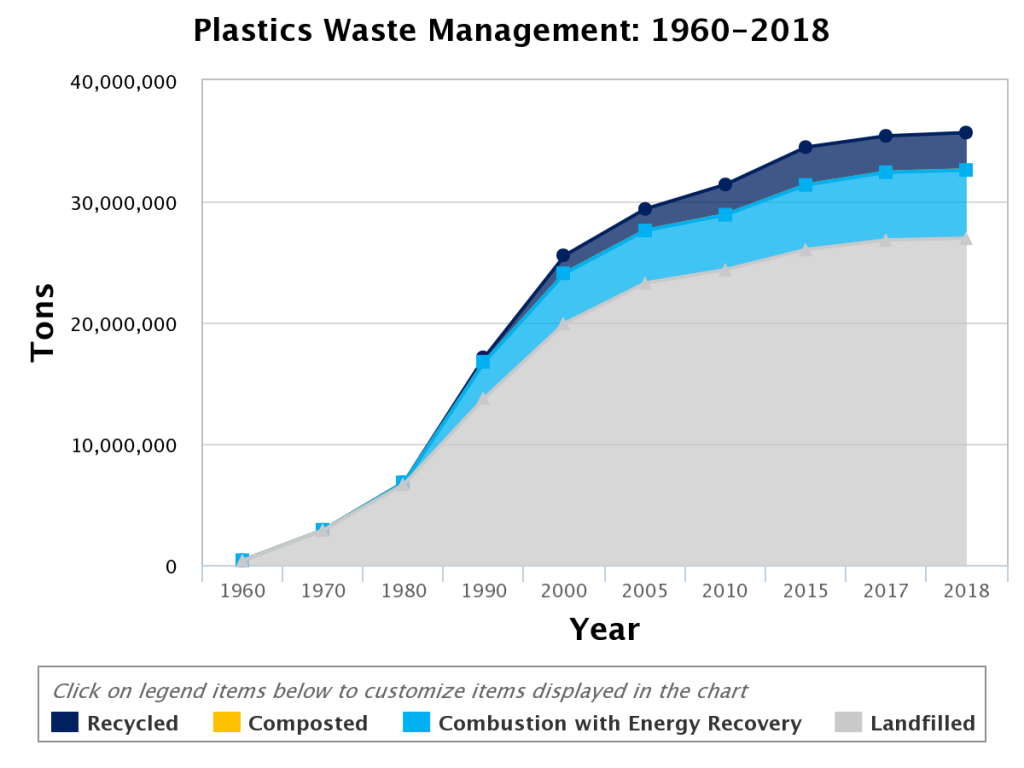
Poor plastic waste management is the issue, as indicated in the statistics below.

A considerable percentage of our plastics still end up in landfills where

  • 92% of the collected waste in the United States and
  • 69% across Europe are diverted to landfills or waste incineration plants, and
  • only 14% of the world’s plastics wastes are collected and recycled.
Thong Guan Why focus on post-consumer recycled resins plastic waste management

(Source: The United States Environmental Protection Agency)

As such, we see more stakeholders—policymakers, governments, manufacturers, companies, and institutions jumping on the PCR resins bandwagon.

Of course, there are other reasons like crude oil prices, Covid-19 global pandemic effects on global production and demand, supply chain and market disruptions, financial impacts, and more.

Though sustainability is not the only reason. But holistically, it impacts the overall business ecosystem and global economy.

However, we want to take the perspective from your company as our customer. 

Here are four reasons why using post-consumer recycled resins in your new products will help your company.

Advantages of Post-Consumer Recycled Resins in Your Packaging Films 

1. Lower your company’s carbon footprint, improve sustainability score, and enhance your ESG goals

Using post-consumer recycled resins can lower your company’s carbon footprint (greenhouse gas/carbon gas emissions) compared to virgin resins in your new products. 

Contrary to general perceptions, using post-consumer recycled resins in your new products versus virgin materials

  • is more cost-effective, and
  • use more energy and emit more carbon.

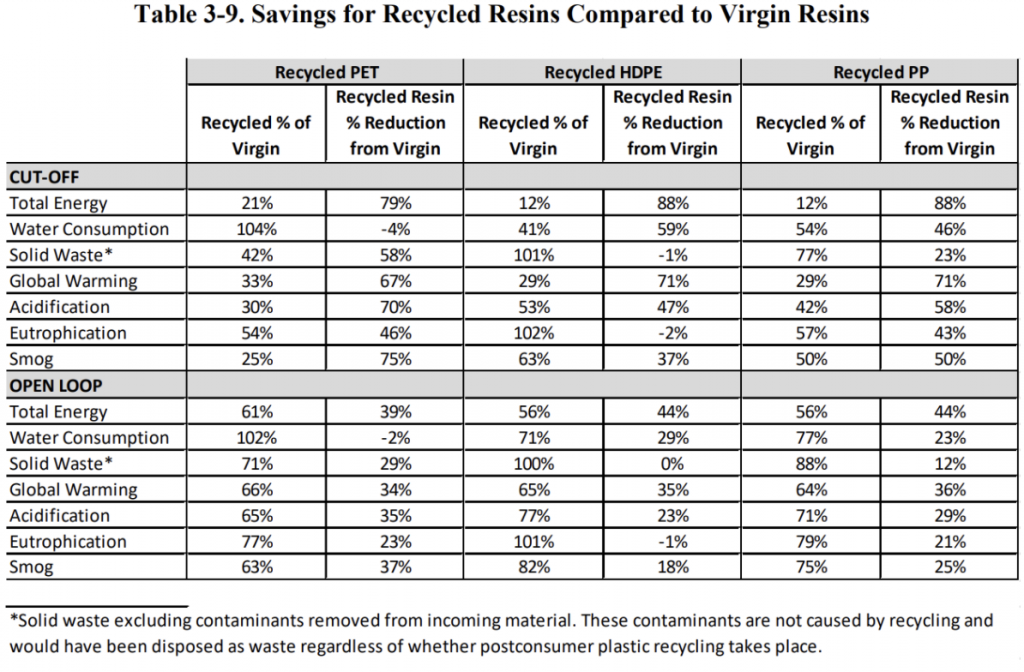
According to the report published by the Association of Plastic Recyclers (APR), it concludes that using post-consumer recycled resins in your new product reduces greenhouse gas emissions compared to virgin material.

The study has taken into consideration the lifecycle impacts, which means 

  • fuels required to run collection trucks,
  • resources needed at material separation facilities, and 
  • energy to process the materials into flakes and pellets.

Here’s the concluded table showing all 84 categories investigated.

(source: https://plasticsrecycling.org/images/library/2018-APR-LCI-report.pdf)

Similarly, the recently published research by Oregon’s Department of Environmental Quality also highlighted that using recycled content has environmental benefits relative to virgin materials. (source: https://www.oregon.gov/deq/mm/production/Pages/Materials-Attributes.aspx)

2. Improve your ROIs and be less dependent on petrochemical market pricing volatility

The petrochemical market is volatile.

This means crude oil prices will continue to increase (as seen throughout most of 2018). As such, plastic resins price is subjected to surges constantly. 

Fortunately, the cost of PCR resins is much more stable compared to virgin resins.

So, you don’t have to subject yourself to the volatility of the market.

Also, let us help you with ‘thin’ gage films that also reduces the amount of virgin resins required in your films.

Thus, improving your total costs and return on investment as well.

Furthermore, under the law of supply and demand, more PCR resins adoption means marginalising the PCR resins cost in the long run.

3. Enjoy the same, if not better, benefits as pure virgin materials films

At Thong Guan, we constantly preach about, “there is no such thing as wrong film, only inferior vs quality films.”

And achieving quality films means meeting the film requirements of our customers based on their needs—as we have detailed how we can achieve that in our #RecycledPlasticsSeries articles, comprehensively.

As such, we can proudly say you will still enjoy the benefits of all the functionalities of standard virgin-material films, while achieving your sustainability.

You may check out our latest NanoGreen high-quality machine film, or you can email us at info@thongguan.com to ask about our recycled garbage bags for your next purchase.

4. Be more regulatory friendly & exempt from taxes 

Lastly, due to the demand for sustainability adoption, regulations favour recycled content packaging and products. 

PCR resins are becoming increasingly regulatory friendly.

Therefore, with sustainable packaging on your inventory, you can meet environmental impact regulations post on your company by your local government.

Additionally, you can get the plastic tax exemption if you are shipping to the UK with plastics packaging that contain more than 30% recycled plastic

This will take effect from 1 April 2022 onwards.

Conclusion

There are many more benefits of using post-consumer recycled resins packaging to add to the top four benefits we believe matter to your business. 

For instance, 

  • better branding
  • better customer relations in fulfilling consumers demand for sustainable products
  • better margins with higher price points, again due to the demand
  • long term sustainability for economic growth

All the more reasons why we should focus more on post-consumer recycled resins.

If you are ready to get on board. Talk to our sales representative by emailing us at info@thongguan.com.

PCR Resin: Giving Life To Post Consumer Waste (PCW) Again

PCR Resin TGSH Thong Guan

Are you aware of the buzz surrounding PCR resin in the packaging supply chain? 

With all the talks about joining in the sustainability movement, one of the ways to close the loop is to use post-consumer recycled materials instead of virgin feedstock in packaging. 

The movement and demand of PCR resin have grown enormously over time. 

The global “Post Consumer Resin (PCR) Market” research report showed that the “Global Post Consumer Resin (PCR) market was valued at USD 30,450 million in 2020.

It is estimated that it will reach USD 42,470 million by the end of 2027, growing at a CAGR of 5.7% during 2022-2027”. 

More users and consumers of packaged goods businesses are placing more weight on sustainability, using less energy, and lessening waste. 

Brand owners are also aware that sustainability goals are more important now than ever, as consumers seek out brands focused on the environment.  

In this article, let us learn more about PCR resin and how it plays a role as a #loopcloser to bring you a step closer to your sustainability goals. 


What Is PCR Resin & Why It Matters

PCR plastics refer to any plastic material that is made from post-consumer resins. 

Post-consumer recycled (PCR) resin is the recycled product of external waste created by consumers. 

The International Organization for Standardization’s (ISO) “Plastics Vocabulary” list, the definition of post-consumer or post-use material as 

“material generated by the end-users of products, that has fulfilled its intended purpose or can no longer be used (including material returned from within the distribution chain).” 

These wastes are called post-consumer waste (PCW), which are not usable anymore because their functionalities have already been destroyed.

They are gathered and sent through a process to produce plastic resin pellets.

These pellets are then turned back into valuable products. 

They are environmentally friendly and a more sustainable option that many manufacturers are beginning to use to support their recycling programs.

It helps decrease the amount of waste sent to landfills and microplastics drifting away into our seas. 

Why does this matter? 

It is because we want to strive towards a sustainable environment of minimal waste where plastics may live useful lives again.

We are moving towards a culture of recyclability and closing the circular loop. 

You should join in the movement too. 


What Are The Advantages Of Using Renewable Recycled Material:

Here are some advantages when more recycled material like PCR resin is used in the supply chain and our environment. 

  • Waste reduction – Plastics do not biodegrade and take up to 500 years to decompose in a landfill. Recycling lessens the usage of valuable landfill space and greatly reduces ocean-bound plastic.
  • Energy conservation – When we reuse existing materials, we use significantly less energy compared with the processing of raw, virgin materials.
  • Conservation of precious resources – Using recycled materials protects valuable natural resources like oil, which is limited and non-renewable.
  • Reduce carbon footprint – Manufacturing produces greenhouse gases, such as carbon dioxide which is harmful to the environment. In addition to its effects on climate change, its toxic smog and air pollution affect our health. Since less energy and raw fossil fuels are required during its compounding process, greenhouse gas emissions and carbon footprints are also reduced. 


Collecting Unwanted Packaging Waste To Live Useful Lives Again

To reprocess Post Consumer Waste (PCW), Thong Guan collects cleaned and packed waste to be recycled. 

There are two ways that waste is collected.

  1. Plastic packaging waste from “used packaging” that is used to package raw materials received (i.e. resins)
  2. Plastic packaging waste from other suppliers in the supply chain 

Some of these wastes consist of PE sheets, bags, and stretch films. 

We collect these usable consumer waste from suppliers, which usually comes in form of big palletized packs or resin-loaded containers

By recycling these discarded wastes back into the packaging ecosystem, we convert them into valuable raw materials – completing the circle to close the plastic loop.


How Does The Process Work and The Valuable Role Of PCR Resins?

In order to convert PCW into PCR plastic resins, Thong Guan follows a series of steps that we carefully follow to ensure quality output.

And that’s vital for quality films and bags production. 

Here are the steps below

  1. Collection and sorting: The process starts with the collection of packaging materials (PE Sheets/Bags/Stretch Films/Stretch Hood) of the raw materials (resins) that comes in from Thong Guan’s plants that will be sorted, compiled and collected
  2. Compression Process – PCW wastes are then compressed into a bale and made ready for transfer
  3. Waste Processing – These PCW wastes will be transferred over to TGSH Plastic Industries for processing 
  4. Flaking – TGSH will start processing these wastes through a flaking process. These PCW waste will be flaked into a silo 
  5. PCR Resins Production – After the PCW waste is flaked, it is converted into PCR resins (Post Consumer Recycled Resins) 
  6. Extrusion Process – PCR Resins are then included in the extrusion process to create newly recycled plastics
  7. PCR Plastics – Extruded plastics are ready and made into PCR based products like garbage bags, ready to live useful lives again. 


Why it’s time to start using PCR Resin

As the world moves towards sustainability, introducing recycled materials in your products is inevitable. 

The fight for our environment is not something we can shoulder alone.

Whether it is compliance pressure from the government, consumer preference to go green or your initiative to fight for our environment, Thong Guan strives to innovate to help you minimize your packaging footprint and make good packaging wastes. 

With the growing demands for recycled materials, it is essential to establish a closed collaboration with users in the packaging supply chain.

Together we can achieve sustainability goals as we lean towards PCR resin and loop closing initiatives. 

Would you like to learn more about using recycled materials?

Let us talk about PCR resins and other #loopclosers at info@thongguan.com