Stretch film breaks and tears are common for many businesses.
That means potential wastes that can be detrimental to your bottom line.
The good news—it is preventable.
Continue readingStretch film breaks and tears are common for many businesses.
That means potential wastes that can be detrimental to your bottom line.
The good news—it is preventable.
Continue readingShrink films are often considered to be one of the best packaging materials because they allow you to keep your products safe and secure.
However, choosing the best solution can be challenging because there are several types of shrink films available on the market.
For businesses. it is important to conduct thorough research to make sure they are choosing the right type of stretch film to protect their products and improve the customer shopping experience.
In this post, you will get to know about the major types of stretch films and their pros and cons. So, let’s get started:
PVC is thin and light, which makes it significantly more affordable than the other shrink films.
It is capable of shrinking only in one direction and has high resistance to tears and punctures. PVC is quite attractive because it has a shiny texture
PVC is vulnerable to wrinkles and extreme softening at very high temperatures.Similarly, it can get too hard and brittle at very low temperatures.
Businesses also have to make sure that they are using PVC only with inedible products because it has chloride in it due to which can emit toxic fumes in heating and sealing.
This stretch film also has strict disposal standards to ensure proper disposal and sustainable development.
Polyolefin has been approved by the regulatory organizations to package edible products because it does not have any toxic elements or components that can damage the food products.
Moreover, it does not produce any significant smell during the heating and sealing process. Generally, the polyolefin is considered to be the best stretch wrap for irregularly shaped packages because it shrinks much more than other stretch films.
The glossy surface of the film gives an attractive look to the entire packaging. It is also a highly reliable stretch wrap when you want to store multiple products without getting worried about punctures and tears.
Polyolefin is an expensive shrink film as it costs much more than a traditional PVC film. Moreover, you might have to perforate the polyolefin films in some situations to reduce or eliminate air pockets and bumpy areas on the films.
There are many different benefits of polyethylene films, due to which they have become an extremely popular option for most organizations, stores, and warehouses. It is typically used to wrap multiple packages of heavy items like water bottles and beverages.
Moreover, polyethylene films are durable and can easily stretch much more than the other types of stretch films. It has also been approved by the experts to use for the packaging of the food products.
Another interesting aspect of polyethylene is the fact that its thickness can be scaled up to 1200 gauge. It means it is suitable for wrapping massive objects like boats and other similar vehicles for storage purposes.
A major disadvantage of using polyethylene is that it has a significantly low shrink rate, and its surface is not as clear as the other kinds of shrink films.
Moreover, polyethylene is more expensive than other stretch films, due to which it can be difficult for companies, especially small-scale businesses, to keep affording them over the long term.
Some of the many benefits that you can enjoy by using stretch films to wrap your products are:
The durability of the shrink films plays an important role in protecting and preserving the contents of the packaging. It allows you to easily ship your products and have peace of mind that the products will be transferred in a safe and secure manner.
They are also useful in increasing the shelf life of the perishable items and concealing the smell of the products.
If you use attractive stretch wraps like Polyolefin films, they can make the entire packaging look much more appealing to the customers.
Modern technology also allows companies to customize the packaging at an affordable rate. These factors are important in the branding and long-term success of your business.
Great advancements are being made in the packaging industry, due to which a wide range of eco-friendly stretch films is available in the market. Companies have the option of switching to these stretch wraps to promote eco-friendliness and sustainability.
Shrink film is a versatile packaging solution used across various industries due to its protective, tamper-evident, and cost-effective properties. It is widely applied to food products, ensuring freshness and hygiene for items like baked goods, fresh produce, and frozen foods. Many food manufacturers opt for FDA-approved polyolefin shrink film for safe and high-quality packaging.
In the beverage industry, shrink film is commonly used for bottled drinks and multipacks, keeping them securely bundled during storage and transportation. Its ability to conform tightly around products makes it ideal for packaging multi-unit beverage packs, such as bottled water, soft drinks, and canned beverages.
For retail and consumer goods, shrink film provides a clear, professional presentation while protecting items from dust, moisture, and tampering. It is frequently used for packaging electronics, cosmetics, personal care products, toys, and household items. The ability to apply branding or tamper-proof seals makes it a preferred choice for e-commerce and retail businesses.
Additionally, shrink film is extensively used in industrial and warehouse packaging for securing palletized goods, hardware, and machinery parts. It helps maintain product integrity, prevents shifting during transportation, and improves warehouse organization. Heavy-duty shrink films, such as polyethylene, provide extra durability and puncture resistance, making them suitable for wrapping large or irregularly shaped items.
Overall, shrink film is an efficient and reliable packaging material for a diverse range of products, offering protection, visibility, and cost-effectiveness in various industries.
Finding the right stretch films depends on the kind of business you have and the kind of products you pack.
Now that you are familiar with the various types of stretch wraps available on the market, you should have no issue choosing the right kind of stretch film for your business and products.
For further information, please do not hesitate to get in touch with our specialists.
Stretch Film Dispensers are plenty in today’s market, but one main problem during the palletization process still exists.
Continue readingPacking and packaging testing methods have become increasingly important considerations for e-commerce.
Since the global COVID19 pandemic, many shoppers have switched their shopping habits. It is now the norm for end-users to order goods from both local and international sellers.
It has pushed e-commerce trading in reaching new transactional volumes.
According to a report by Digital Commerce 360, online sales has added $105 billion in U.S. online revenue in 2020, accelerating its growth two years ahead of its expected development time.
The producers of e-commerce, like Amazon, Taobao, Lazada, and Shopee, have a tremendous volume of transactions, which are popular and highly in demand.
Online shopping has also become increasingly fashionable. If the product’s delivered packaging does not look intact as promised, it will affect the platform’s reputation and product sales.
To ensure you have the right results delivered, you need to make sure that your packaging is optimized.
What are some of the problems that e-commerce businesses may encounter? Some of these you may sound very familiar to you:
Testing your packaging is essential because some processes during the distribution cycle can risk the product’s stability. Carrying out rigorous tests to assess the packaging builds your goods’ marketability and confidence of your customers.
Although a product can be technically perfect, packaging defects can lead to its failure. First impressions are essential and visual appeal is key in driving consumer behavior.
Ensuring that your product packaging is perfect goes a long way. Without it, you risk product damage during shipping or even without the proper protection at all.
Your product may be shipped in a condition that makes customers think twice about buying from you again.
Your packaging must be strong enough to withstand the demands of environmental and transportation conditions while remaining safe and secure, as promised. Testing your packages gives you confidence that your packaging will be able to safeguard your goods from damage or degradation during the distribution and shipping process.
Ultimately, it builds the satisfaction of your customers, contributing to increased market share.
The best packaging testing methods are those that can simulate the actual process cycle that your distribution goes through.
Here is how Newton Research & Development Centre can help optimize your packaging testing to get the best value in return. We are equipped with the latest equipment and can provide reports when we work with our various packaging testing methods.
We can help simulate the journey of your package from the manufacturer to your customer’s doorstep.
Newton offers a one-stop solution for product packaging testing services that reproduce the routine and climatical settings that goods may face during shipping and storage.
Every package is unique in content, weight, and delivery distance, which will impact your delivery performance. We make it a point to ensure these variables are factored in and diagnose to ascertain your product’s susceptibility to damages.
So how exactly are these packages for e-commerce tested? Packages will be subjected to a series of tests following a set of procedures. Packaging testing methods include:
Pandemic or not, e-commerce is here to stay as it has become a way of life. There will be many more blooming businesses utilizing packaging to reach their customers locally and internationally.
The question is, how would you remain competitive, and how your packaging plays an essential role in delivering your promise to your customers?
Partnering with packaging testing labs like Newton Research & Development Centre can help you simulate and replicate packaging conditions so that you won’t be caught by unwanted surprises which may disrupt your business flow and productivity.
A problem in your packing is the last thing that you want to worry about.
Let us optimize your packing decisions using data technology combined with the right packing testing methods to fulfill your packaging needs.
Let’s connect and get you on track so that you can run ahead in this rapidly, ever-growing e-commerce market.
Contact us at info@newton-centre.my for more info or to enquire more today.
** This article is contributed by Newton Research & Development Centre, our trusted partner for Thong Guan’s ENGAGE program.
Cold chain wrapping with machine film can be quite challenging for meat, ice cream, seafood, frozen food, pharmaceutical, or any cold room logistics business.
The typical cold chain temperature may range from 2°C to 8°C (36°F to 46°F) to ensure maximum freshness.
For instance, transportation of fruits, vegetables, medicines, food items, and many other environmentally sensitive products.
Some products have specific temperature tolerances depending on their specifications, sensitivity, and type of logistics used.
For instance, vaccines, namely Ebola and Pfizer–BioNTech COVID-19 vaccines, require –70ºC (–94ºF) cold chain.
Here are three condition checklists when considering cold chain packaging:
When dealing with conditional sensitive goods, we know that slight shifts in temperature conditions during transits make a difference to your business.
Changes cause damage and deterioration that will ultimately affect your bottom line.
It is crucial to preserve the integrity and extend the life of products throughout their journey to ensure happy customers.
The best-fit cold chain wrap helps maintain a stable and consistent temperature from manufacturing to the destination of delivery.
Conventional machine stretch film loses its load-holding force and clinginess when in a cold room environment.
It clings when it’s warm, but when put into temperature variation situations, it loses its cling.
Stretch film meant for safeguarding and protection becomes loose and will eventually fall off, defeating the wrap’s purpose.
Since conventional stretch films cling properties are not as good in cold room environments, it often leaves “a tail” when the end of wrapping falls off.
This can be unsightly and hazardous for employees.
You certainly do not want mishaps of trips or messy tangling between the wheel of pallet jacks and forklifts during the storage process, which causes unintended additional costs, which affects your bottom line too.
To withstand freezing and conditioned cold environments, you would need to use specially manufactured films to maintain excellent load holding and cling force.
Freezer film like Thong Guan’s Nano Arctic is designed with extra cling properties, enabling the film to be used in freezing temperatures to secure your sensitive temperature goods on any piece of equipment.
It assures that your products’ quality is protected and preserved just as promised to your end customers.
At the same time, you reduce possible losses due to temperature-based damages too.
Even when freezing, refrigerated, or in controlled room environments, Nano Arctic film will stick to each other, especially at the end of the film or wrapping cycle, leaving no tail.
No more worries about film causing unnecessary mess or trouble during storing and in-transit.
Construction companies, modeling, landscaping, and other packaging industries could benefit from using Nano Arctic due to its shielding and aggressive cling properties.
It also protects your load containment so that you will never have any mishaps during transits.
The Nano Arctic cold chain wrapping film is made with high clarity with clear visibility that anyone can inspect the goods or scan the barcodes inside. Moreover, it is advantageous for your brand to be visible for branding purposes too.
In the end, it is all about ensuring that consumers get fresh products delivered according to the standards.
It does not matter if your cold wrapping needs are for ultra-low temperature refrigerants, phase change materials, or insulated shipping containers.
Perishable temperature-sensitive goods are highly delicate items that need special packaging care to keep happy customers.
Thong Guan can help you enable machine film to be used in cold room environments or extremely cold weather conditions.
We help optimize your wrapping by selecting the best-fit film using data technology at the most optimum wrapping based on your needs.
Let’s connect and get you on track towards choosing the right stretch film for your machines today.
Contact us at info@thongguan.com for more info or to enquire more today.
According to the New European Green Deal, all plastic packaging consumed in the European Union must be recyclable by 2030. According to IndexBox’s estimation, the EU plastic packaging market totals $31billion.
This huge figure will force manufacturers to switch to making plastic packaging suitable for subsequent recycling and multiple reuses.
Meanwhile, in the future, we expect the production of non-recyclable types of packaging to decrease while stricter waste controls could push the plastic packaging market to transform supply chains.
In 2010, the EU plastic packaging market grew by 2.6% against 2009, expanding slightly to $25.4billion.
This figure reflects the total revenues of manufacturers and importers minus retail marketing costs, logistics costs, and retailers’ margins, which will be included in the final consumer price.
In comparison with the prominent rate of growth recorded in 2008 when the market increased by 6.6%, the growth record between 2009 and 2010 was a mild downturn.
In value terms, $25.9billion plastic packaging production was recorded in 2010 estimated at export prices. Over that period under review, the rate of production remained at a lower figure.
Fast forward to the next decade, the average annual production of plastic packaging, though increased over the decade, further decreased due to the covid-19 pandemic.
According to the latest statistics from Eurostat, the dynamics of plastic packaging production in 2020 was approximately equal to the volume of 2019.
As we speak, the EU plastic packaging market totals $31billion. In 2010, the countries with the largest plastic packaging markets in the European Union were Germany (1.3million tonnes), Italy (1.3million tonnes), and France (1.1million tonnes).
Altogether, they accounted for 52% of the total market. These countries were followed by Spain, Poland, the Netherlands, Belgium, the Czech Republic, Austria, Lithuania, Portugal, Sweden, and Hungary, which together accounted for further 39%.
From 2007 to 2010, Poland recorded the most notable rate of growth in terms of plastic packaging production, amongst the main producing countries while others experienced modest paces of growth.
In 2021, the highest plastic packaging production in the EU includes Germany ($4.8billion), France ($4.7billion), and the United Kingdom ($4.2billion). Altogether, they account for 44% of the total production.
Other EU countries like Spain, Italy, Poland, the Netherlands, Belgium, Sweden, Denmark, the Czech Republic, Greece, and Romania followed suit, which together accounted for a further 46%.
In recent years, the demand for bulk plastic packaging has increased especially during the pandemic. Hand sanitizers were sold enormously and guess what the bottles are made of – plastics.
Since they are easy to wash and disinfect, the continued popularity was inevitably leveraged by retail packaging. The rise in demand for retail packaging came also a result of the limitations in the HoReCa segment which have led to changes in sales channels.
The pandemic raised an alarm for people to pay attention to hygiene and safety. As a result, people were more conscious of their health as usual.
During the period of isolation, most restaurants, cafés, shops, and offices began to subscribe to home delivery services that involve the consumption of plastics.
The rise in contactless shopping further led to an increase in the consumption of plastic packaging like plastic bags, stretch films, and containers.
Since consumers are mostly cooking at home, plastic packaging manufacturers saw an opportunity to extend their range of containers to suit different eating and cooking scenarios.
We began to see diverse ranges of plastics in different shapes, dimensions, and sizes, to meet the demand of the market.
The problem this caused was the large amount of carbon dioxide emitted into the atmosphere during the process of recycling plastic packaging. As a result, the European Green Deal was born.
The European Green Deal aims to reduce greenhouse gas emissions by at least 55% by 2030.
To achieve this, European plastic packaging manufacturers will be forced to use carbon capture technologies in their plants, or research other ways to reduce carbon footprint, and this could lead to higher costs of recyclable plastic packaging.
Since plastic containers are incredibly low-cost to produce, lightweight, and easy to wash and disinfect, the need for home food delivery will continue and retail packaging will continue to be relevant.
Therefore, taking into account the development of plastic recycling, we will not expect any radical abandonment of plastic packaging.
Plastic packaging manufacturers had better get prepared to face the New Green Regulation.
Stretch wrapping machine films is a significant investment for manufactures, distributors, and logistics firms. The right machine film fulfills packaging promises and retains loyal customers too.
A new research study by Persistence Market Research reports that the consumption of stretch wrap machines will be at 231,810 units by the end of 2026. They also projected the revenue from the purchases of stretch wrap machines to touch US$ 1,356.0 mil by 2026, showing a strong growth rate of 7.5% during the eight years from 2018 to 2026.
Mechanical stretch film wrap applications work best when working with mass load packages that need to be optimally wrapped so that you can deliver what you promise your customers.
However, one of the most significant issues is deciding which type of stretch film for machines to use to keep your goods safe. These considerations include cost, ease of use, durability, and transparency. You must give each of these factors the same amount of importance.
Stretch film wrappers work with loads according to:
But what are the considerations when choosing stretch films for machines?
While the purchasing department continues to opt for cheaper films due to costs, productions jump on snap films and downtimes.
So regardless of what wrapper is being used, choosing the right film for your machine matters.
Here’s our take on how the films and wrapping machines correlate to your wrapping goals, how to select the right machine films.
Stretch Wrapping Machine Film
Smart technology and high-speed production processes drive automation to the next levels in the global packaging industry.
Through evolutionary patterns, mechanical stretch film wrap minimizes the quantity of material used to protect loaded pallets from unwanted losses.
The result of utilizing mechanical wrap benefits you in
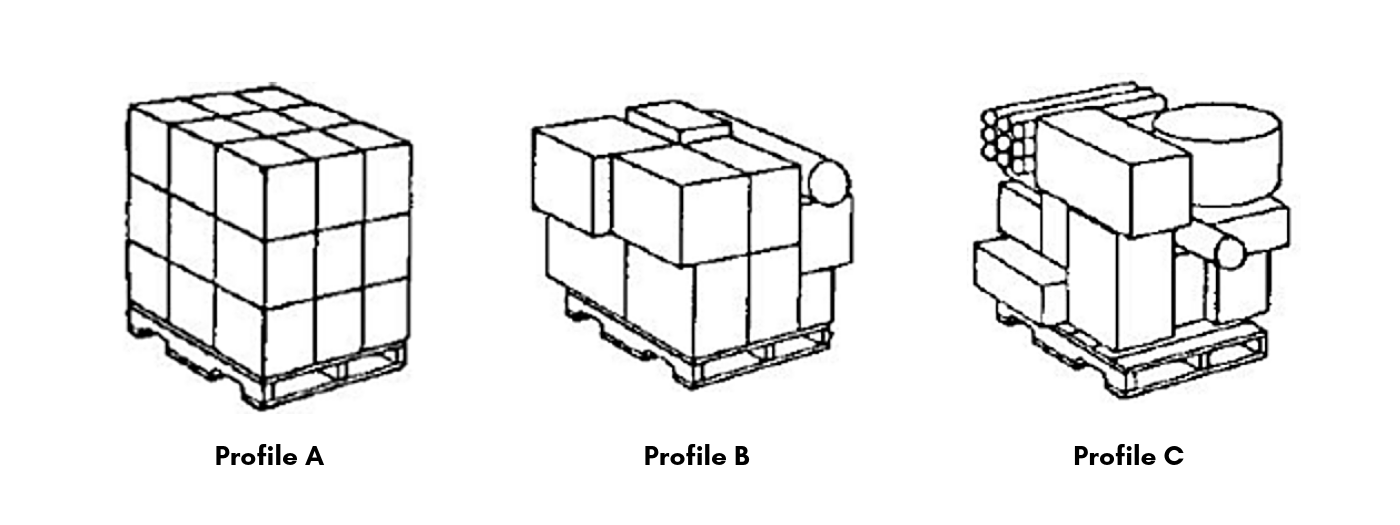
Different machines work with different loads. There are three types of loads when dealing with pallet wrapping which are:

Here’s how these machines work with your wrapping needs
The most simple form to wrap is to place the pallet on a turntable that rotates while a pallet stretch film is delivered around the load.
Turntables have the smallest footprint and overall machine height. It is capable of 10– 20 loads per hour and ideal for A and B load types. This system starts wraps at the bottom of the load and wraps its way to the top and to the bottom again.
With the speed of 16 rpm p/minute it takes 5 mins (including change over time) to wrap a pallet. That’s approximately about 12 pallets per hour.
Turntable wrappers are very effective in many types of works, and they are used for a broad variety of applications
Arm wrapper machines operate by placing loads under a rotating arm. The load remains secured and stationary while stretch film is revolved to wrap around the load.
These machines are great for unstable, wobbly, light pallets and heavy loads that tend to be unstable while rotating on a turntable.
Suitable for all A, B, and C types of heavy and oversized loads. They are used for high-speed applications from 40 loads per hour.
Ring wrapper machines are great for unstable loads as well.
Best used for PET drinks, 25kgs resin bags, brewery, and products required high throughput yield.
When wrapping, the load remains stationary while the wrapping is done via rotating around the pallet not by an arm, but through a large ring.
These machines can wrap at a very high-speed ranging application of 60 to 80 loads per hour.
Here is a summary of good types and what type of stretch film fits best
Typically, the usual market practice uses 23 microns for heavy loads, but Thong Guan has innovated the use of thinner < = 17-micron films that do the same job but better.
When film is applied using a stretch wrapping machine, the rolls are larger, typically having a 500 mm and 750 mm width and a gauge of 20 microns and above. Thong Guan is currently looking to replace it with 15 microns and below. The film is pre-stretched via the machine’s carriage system immediately before application.
Combining the right film and advanced wrapping machine, the film can be pre-stretched by as much as 400%, which is 1 meter to 4 meters. Less efficient machines have a lower pre-stretch capacity, generally less than 150%
The type of wrapping machine is also important since there is no point in using a longer stretch ratio film if the wrapping machine has only limited to lower stretch ratios (e.g., 150% and below for core brake turntable machine)
Here are four questions that would be able to help you in determining the suitable stretch film for machine
With the above information available, we can use formulas to calculate the true pre-stretching of the winding film on the device.
It doesn’t matter what stretch wrapping machine you need for your applications Thong Guan can help you optimize your wrapping. We can help you select the right film using data technology combined with the right machine scratch film to optimize your wrapping demands.
Yes, choosing the right stretch film for a machine may not be as easy as just purchasing a “cheap and good” film as there are many other factors mentioned to consider too.
As stretch film experts, let’s connect and get you on track towards choosing the right stretch film for your machines today.
Contact us at info@thongguan.com for more info or to enquire more today.
We all know that stretch film is essential for your business, particularly if you are brand owners or in manufacturing, distributions, and logistics.
We understand that the last thing you’d want is high unsaleables. That translates to a compromised bottom line.
That is why optimum wrap is critical to your entire business.
And one of the most vital steps to optimum wrap is selecting the right gauge stretch films.
Of course, to achieve optimum wrap with the best-fit stretch film, we will need to know your wrapping requirements, wrapping methods, and more.
However, there are many stretch films in the market, so what are the essential elements of a good stretch film and selection principles for your achieving your wrapping goals?
Here is a list of essential checklist for optimum wrap:
Films are not created equal. Depending on the technology, quality control, and materials, films come in various levels of quality.
And on top of that, there are different types of films with different tension points, tear resistance, layers structure, durability, clarity, and thickness.
So it is essential to find the best films for your different wrapping scenarios like the loads, branding requirements (namely clarity), and handling conditions.
Also, Stretch film comes in different sizes and thicknesses (gauge) that can and must be paired with your pallet load requirements.
You don’t have to worry about your loads falling apart or being damaged along the journey during a delivery.
Some of the loads that you may be dealing with are:

A good stretch film would hold your loads together no matter the type of load you are working with.
Thong Guan’s nanofilm series provides a different kind of wrapping solution of different types of machines- Ring type, Arm type, Horizontal wrapping, and Turntable type.
No sweat of unwanted complaints—only happy, intact deliveries.
A good stretch film would be able to withstand the pressure of the wrap through its yield strength and gives you optimum containment force.
It is crucial to look for a stretch film that gives you the right yield strength, containment force, and performance for the loads that are being wrapped. It must be able to withstand the stretch stand without permanent deformation.
Before reaching its yield point, a stretch film will elastically deform. However, a good one reacts like a “rubber band” once the stress stops. Stretch films that show such elasticity assures you that your goods will be secured.
What type of loads are you working with?
Choosing the right stretch film thickness to fit and protect your load type goes a long way. It prevents the risks of unwanted tears or film failures.
There is a lot of transportation risk that takes place on the road. This is why using good stretch films takes the headache away from avoidable damages and losses.
EUMOS (European Safe Logistics Association) has established the EUMOS 40509 method, To improve transport safety. Its purpose is to guarantee the cargo’s safety and rigidity under the 2014/47/EU directive.
This directive puts strict demands for the transport of goods on pallets within the EU based on standards issued by EUMOS and no longer holds the transporter responsible for product damage and cargo losses.
Besides its hefty fines, following this guide serves to protect and preserve stakeholders’ and consumers’ trust.
A good stretch film would be able to keep your load pallets safe from your wrapping process to delivery because it can secure your load intact. We at Thong Guan know about the stretch film essentials in Malaysia and global markets too. We would be able to advise you in compliance with EUMOS standards.
in conclusion, here’s a summary of our checklist for your optimum wrap
Choosing the right stretch film is essential.
Partnering with NEWTON Research & Development Centre (the first dynamic simulation lab in the Asia Pacific), we help brand owners like you obtain exact data and obtain the right setting to achieve your optimum wrap goals through state-of-the-art lab testings.
Contact us at info@thongguan.com for more info or to enquire more today.
The #LiveGreen Launch & Sharing Session was held on the 6th of April, 2021, from 3 PM to 5 pm Malaysia Time (GMT+8) on Zoom Webinar.
The purpose of the session was to launch Thong Guan’s #LiveGreen program officially while running a sharing session that talks about ‘Plastic and Its Role in Sustainability for Global Businesses’.
Continue readingWith the continued surge of plastic resins price, what can you do to outsmart the price surge? Consider Thong Guan’s Nano 10-micron.
Continue reading